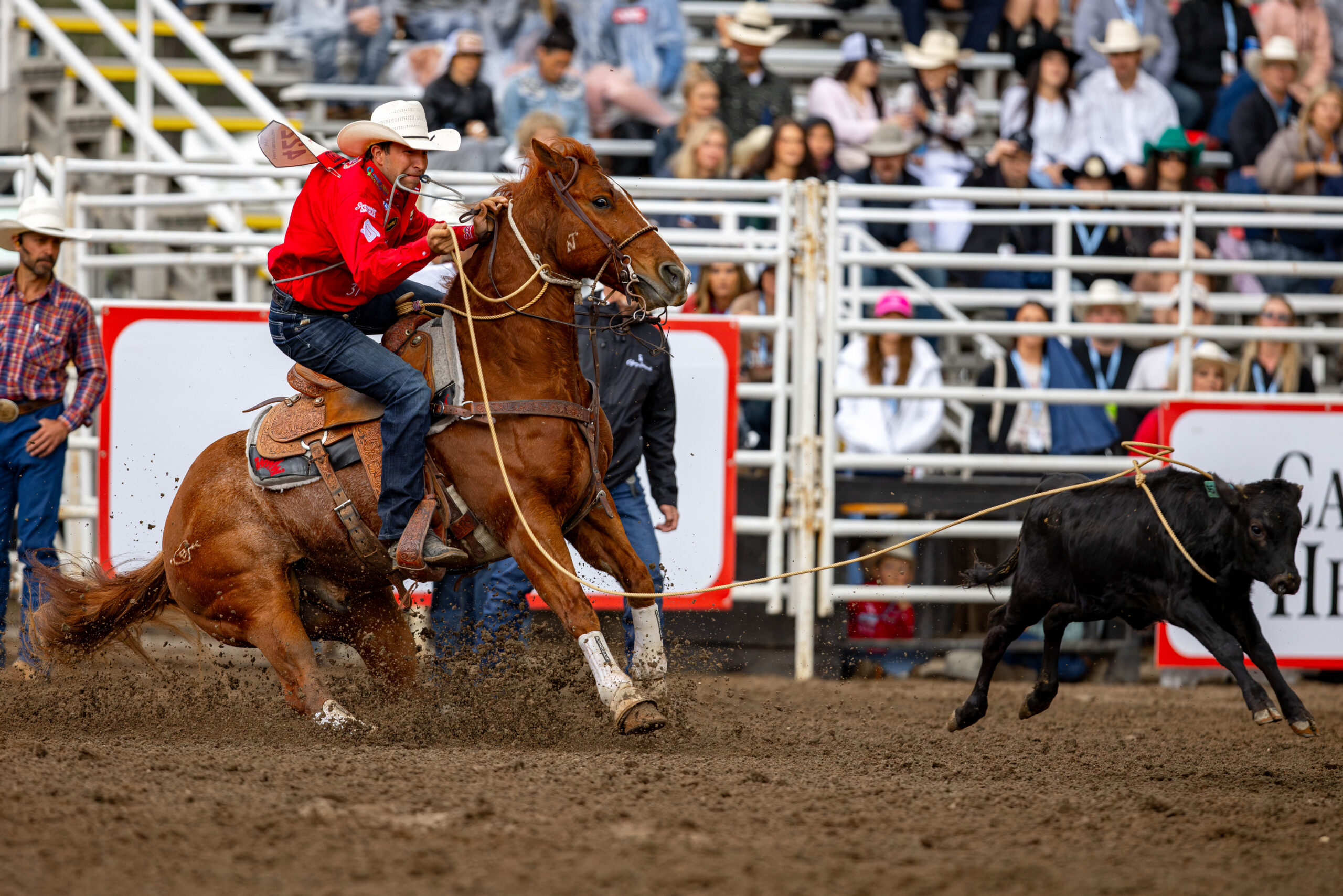
If you’ve been watching the Calgary Stampede tie-down roping on the Cowboy Channel this year, you’ve probably seen it happen: a calf roper makes what looks like a clean run and then the flag comes out for a no time.
The reason is a rule Calgary calls a mishandling infraction. Most of the roping world knows the general idea by a blunter name: the jerk down rule. And judging by the number of questions filling up CalfRoping.com’s comments and inboxes, a lot of fans—and even a lot of lifelong calf ropers—aren’t totally sure what they’re looking at. So let’s walk through it.
What the rule actually says
Here is the language straight out of Calgary’s 2026 tie-down ground rules:
“A mishandling infraction will result in a no time. A mishandling infraction occurs when the calf does not keep one foot in contact with the ground until the completion of the initial switch and lands on side, head or back. Initial switch is deemed complete when the calf has changed direction approximately 180 degrees and is facing the horse from the initial tightening of the rope. If the animal goes to the ground following the completion of a legal initial switch, no disqualification will result.”
In plainer terms, the rule is about that first moment after the catch, when the rope comes tight and the calf turns back toward the horse. Through that turn, the calf has to keep at least one foot on the ground. If the calf comes over hard and lands on its side, head, or back before that turn is complete, it’s a no time.
Justin Maass—eight-time NFR qualifier, 2012 Reserve World Champion, and Roping.com coach— put it about as simply as anyone can.
“The calves, when they come around, they have to have a foot underneath them,” Maass said. “They can actually roll and it’s okay if they roll over, but they can’t come over and land without any feet underneath them at all. As long as they have one leg underneath them, it’s legal.”
That’s the key nuance most people miss. It is not an automatic no time just because a calf goes to the ground. If the calf keeps a foot underneath it through that initial turn, or if it goes down after the turn is already complete, the run is legal. The infraction is specifically about the calf leaving its feet during that first switch.
How Calgary is different from a regular rodeo
Here’s where the confusion really lives, and it’s a legitimate point of difference.
At the vast majority of ProRodeos, tie-down roping runs under the PRCA rulebook. The PRCA has its own jerk down rule (R10.6.5), but it works differently in two important ways.
First, the trigger is different. The PRCA defines a jerk down as bringing the calf over backwards “between 10 and 2” with the animal landing on its back or head and all four feet in the air. That’s a narrower standard than Calgary’s, which also includes a calf landing on its side and centers on whether a foot stayed on the ground through the switch.
Second, and biggest, the consequence is different. Individual rodeos can, and do, set their own ground rules on top of the PRCA rulebook (that’s the ground rules provision, B10.1.4).
Under the standard PRCA rule, an unintentional jerk down is a fine—$150 or $250 depending on the rodeo—but the contestant keeps his time. That’s the default at most rodeos unless the committee has set their own ground rule (the jerk down rule itself is R10.6.5).
A rodeo committee can, however, request a no-time jerk down instead, where there’s no fine at all, the run is simply a no time. There’s a catch, though. It can only be put in place if the calves are prepared to a specific standard. They have to meet a certain weight (the tie-down calf weight standards live in R7.13.1) and be roped and tied a set number of times beforehand, and that has to be documented and submitted by whoever furnishes the calves. If those requirements aren’t met, the no-time version can’t be instated.
Where the calves qualify, plenty of committees do use the no-time rule. Nearly all California rodeos have the rule in place and Reno does now too. On top of that, at every PRCA rodeo, even ones without the no-time rule in effect, an intentional jerk down is a no time. That’s a judgement call left to the judges, and it carries a larger fine than an unintentional one (the rule against intentionally flipping a calf backward is R8.9, and the mistreatment penalties are R8.13).
Calgary’s mishandling infraction is its own, stricter version of the same idea. It’s a no time with no fine, and as stated above it’s triggered by a broader set of outcomes than the PRCA definition. That’s why fans watching the same calf roper week to week see what looks like inconsistency, when really they’re watching two different rules with two different outcomes.
Why the name matters
Part of the confusion is simply what it’s called. Calgary uses “mishandling infraction.” The general rodeo world says “jerk down.” Announcers and broadcasters don’t always land on the same term, so a viewer at home hears one thing on one telecast and something else the next.
Maass—who’s open about the fact that he’s not a fan of the rule itself—thinks the sport would be better served by plain language.
“I think it needs to be called what it is. Period.”
Whatever you call it, the underlying question the judge is answering is the same: did the calf keep a foot under itself through that first turn?
Tough call
It’s worth saying plainly that this is one of the toughest real-time calls in all of rodeo. Everything happens in a fraction of a second, at full speed, with the calf, the rope, and the horse all moving at once. Even someone like Maass who lives and breathes the event admits it isn’t easy.
“I watch calf roping every day and it would be a super hard call for me to make sometimes when it’s in fast motion, full contact, right there,” Maass said.
That difficulty is exactly why reasonable, experienced people can look at the same run and see it differently. It’s also why Maass—again, as a critic of the rule—believes the long-term answer is technology rather than asking anyone to make a bang-bang call with the naked eye.
“I think you have to go to instant replay and have somebody watching who has access to these camera angles and can make the call,” Maass said.
That’s one roper’s opinion, and there are others. But most everyone agrees that the more people who understand what the rule is actually stating, the more sense the calls will make.
What to watch for at Calgary
As the final Pool of calf ropers heads into championship weekend in Calgary, here’s the short version to keep in your back pocket.
Watch the calf through that first turn after the catch. If it keeps a foot on the ground, you’ve got a legal run. If it comes over onto its side, head, or back before the turn finishes, expect the flag—that’s the mishandling infraction, Calgary’s version of the jerk down rule. And remember, at most other rodeos, that same move is a fine, not a no time.