
The Cinch Timed Event Championship has changed over the years. Formats have evolved. Horsepower has advanced. New generations have stepped into the Lazy E Arena.
But the strategy required to win the Ironman has not.
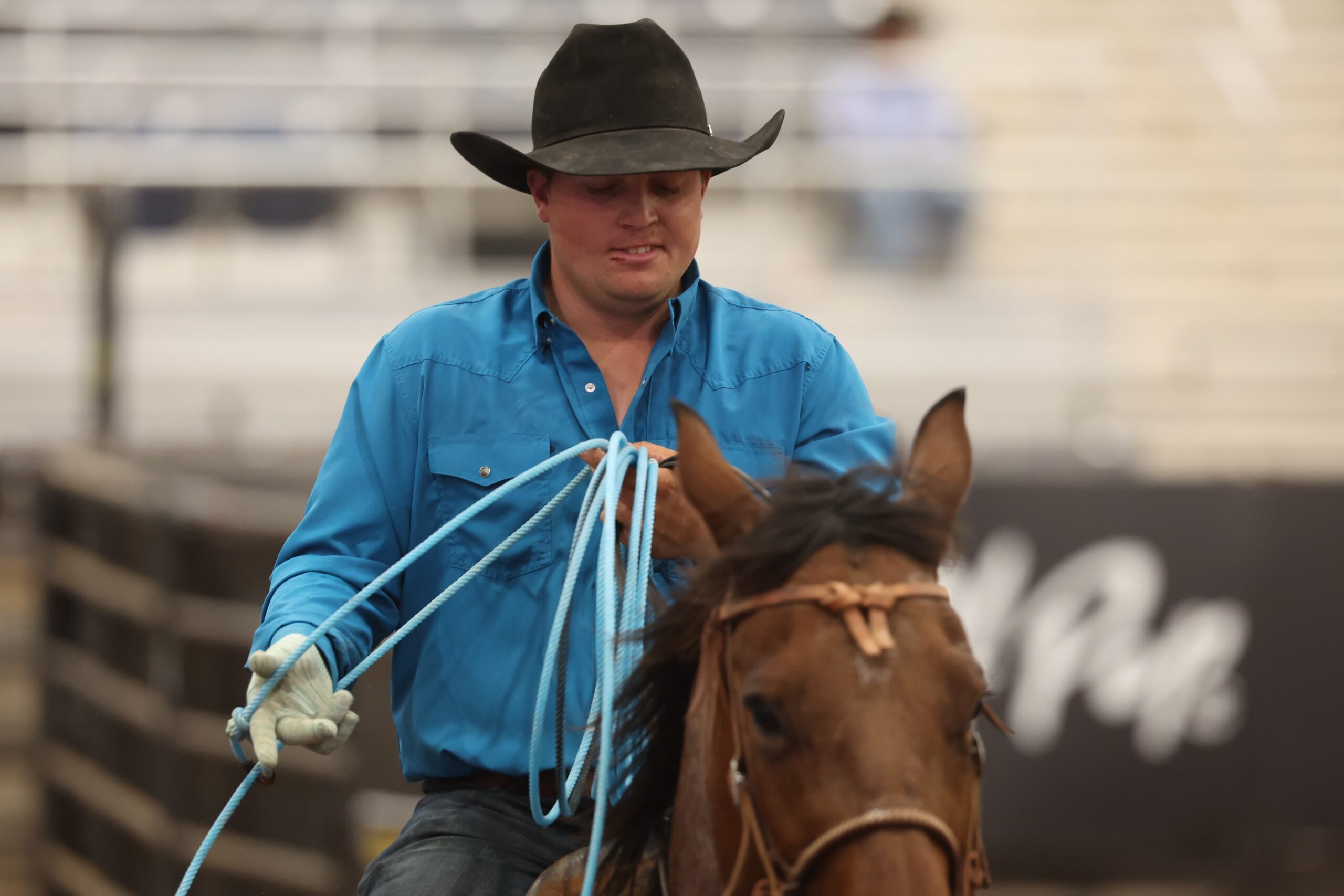
Two competitors at the opposite ends of the experience spectrum prove that in 2026: Ketch Kelton, the youngest man in the field and reigning Ironman champion, and K.C. Jones, the most experienced competitor in the event’s history.
Separated by decades, their answers sounded nearly identical.
“Nothing’s going to change because it worked last year,” Kelton said. “Just go make clean runs. If you don’t get a 60 at any point, it’s a lot easier to win.”
Jones, who has competed at the Timed Event nearly every year since 1992, put it more simply.
“You’ve got to deaw good, then catch first,” Jones said. “It’s real hard to win if you don’t get a time. It gets a lot harder after you get a 60.”
Kelton grew up inside the Lazy E Arena, pushing steers out on a paint pony while his father, Chance Kelton, competed in the Ironman. Jones, meanwhile, was already establishing himself as a fixture of the event—building a reputation for preparation, horsepower, and a mental approach that has kept him competitive across multiple eras.
Their paths never crossed then. But in many ways, Kelton has spent his entire life studying competitors like Jones without ever knowing it.
Jones’ approach was forged early, shaped by his father and reinforced through repetition.
“My dad always said, ‘Get out, get ’em caught, no mistakes,’” Jones said. “He’d make me saddle the horses, warm them up, pin the calves, and then turn them out until I missed. If I missed, I got off and he roped until he missed. The problem was, he didn’t miss much.”
The lesson stuck. Catch first. Then worry about speed.
It’s the same lesson Kelton articulated in fewer words, learned not through decades of repetition, but through one championship run that proved the formula still works.
What separates the Timed Event from any other all-around competition is that it refuses to bend to trends. It doesn’t reward flash. It doesn’t allow shortcuts. And it exposes impatience faster than almost any event in rodeo.
Jones has watched that lesson play out year after year.
“A lot of guys come in their first year and never even get a sniff,” he said. “I was the same way. You don’t really understand what it takes until you’ve been there and felt it.”
Kelton learned it quickly—but the learning curve was no different.
“I know how to go out and complete the course on every run,” Kelton said previously. “That’s what I’m focusing on doing out there.”
Both men point back to the same idea: discipline wins. Not just physical discipline, but mental restraint.
“I’ve made a few changes to how I train these past few years,” Jones said. “My focus is preparing like an athlete. But I’m not giving away those trade secrets until after it’s over.”
For all the differences between generations, the Cinch Timed Event Championship continues to reward the same fundamentals.
Preparation still matters. Patience still matters. And getting a time remains non-negotiable.
Kelton learned it quickly during his championship run a year ago. Jones has lived it for more than three decades.