
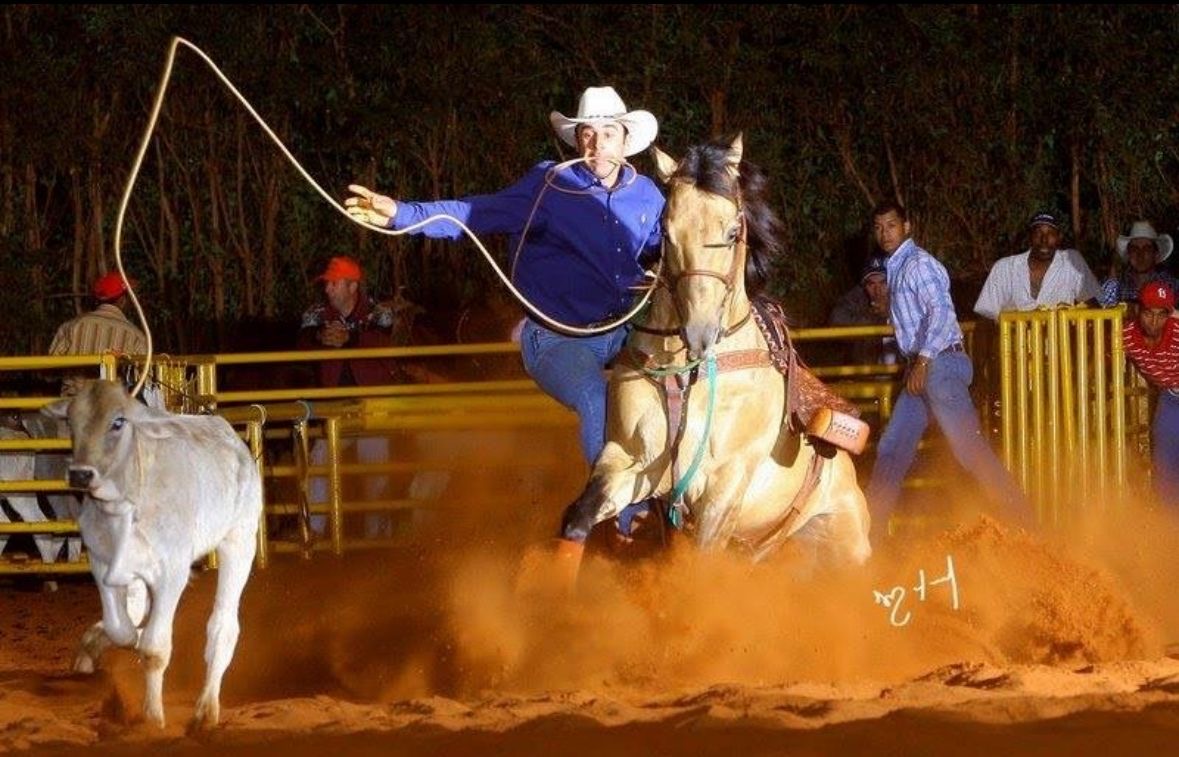
Pilgreen Dun It, the Brazilian calf horse whose style helped define a new era of calf roping in Brazil, died at 25 after a career and breeding legacy that stretched beyond his home country.
Pilgreen was more than a winner for owner and trainer Eduardo Peres-he was his “heart horse”. In Brazil, horsemen now talk about calf horse shows in two eras: before him and after him.
“When he showed up at the horse shows, it caused a huge change in calf horse showing in Brazil,” Peres said through Flavio Ribeiro, a native Brazilian horseman, leather maker and former professor, who translated his answers. “He was very accurate at every maneuver that he made-he had a style of his own.”
Ribeiro said Pilgreen’s style made him recognizable far beyond Brazil. As social media made videos of the flashy buckskin spread like wildfire, American calf ropers started seeing the same thing Brazilian horsemen already knew: Pilgreen could run, stop hard, stay collected and make it all look easy.
“You very seldom would see him making a mistake,” Ribeiro said. “He could really run and drag his ass, and everything was pretty-he always stopped really collected.”
A Stallion Who Made Himself One
Although it didn’t end this way, the family didn’t buy him with the goal of building a program around him. At the time, they didn’t have the mares or infrastructure for that-Pilgreen forced the issue himself.
“He wasn’t bought to be a stallion,” Peres said. “In all honesty, he asked me to be a stallion, and he made himself a stallion.”
When Peres started training the stud, his ability couldn’t help but show through. He was quick, had enough cow sense to shake a stick at and simply loved to do it.
“All the roping maneuvers were extremely simple, and nothing required any kind of force to be done,” Peres said. “He was always having fun roping, and I never saw him break a sweat or be stressed during his training process.”
That bond built one of the most unique pieces of Pilgreen’s career: Peres was the only person who roped on him-not because Pilgreen could not be ridden by someone else, but because Peres felt that bond was worth protecting.
“I never let anybody ride him,” Peres said. “Sometimes I would ask myself if it was selfish of me or not to do that, and I don’t think I was being selfish, but I was being respectful for the respect that I had for him.”
Pilgreen was the caliber of horse that made Peres’ job two things simultaneously – easier because he was so good, but harder because it was all on Peres to put it around the neck.
“The pressure was all on me because if I would catch the calf, I would win the horse show or the jackpot,” Peres said.
A Breeding Legacy Still Winning Today
Pilgreen won nearly everything available to him in Brazil at the time, according to Peres, but his lasting influence may be even stronger through his offspring. After Pilgreen’s first foals started winning and placing high at horse shows, Peres began investing in better broodmares.
“He showed me that all the good traits and attributes that he had, he passed on to his babies,” Peres said.
Today, Peres said they still have 22 calf horses at home by Pilgreen, and they are winning and doing well.
The Brazil–U.S. Connection That Shaped Him
Pilgreen’s rise came inside a Brazilian calf horse industry that is deeper than many U.S. ropers may realize. Through the Brazilian Quarter Horse Association, known as ABQM, calf horses compete in major horse-show events, while independent ropings and associations have helped build a competitive calf roping scene outside the show pen.
“The calf roping industry in Brazil is fairly big,” Ribeiro said. “There is a lot of ropers, a lot of really good ropers-there’s also a lot of amazing horses over there”
That industry has long been tied to the United States. According to Ribeiro, Americans began traveling to Brazil for roping schools in the early 1990s, while Brazilian horsemen also came to the U.S. to learn from top American ropers and trainers. By the late 1990s and early 2000s, the connection had grown through clinics, ropings and Brazilian ropers living and training in the U.S.
Pilgreen himself stayed in Brazil, and most of his offspring did too, largely because of the challenges of bringing horses from Brazil to the U.S. Still, Ribeiro believes the relationship between the two countries will keep growing.
“I believe that the relationship is only going to get stronger,” Ribeiro said. “I foresee more exchange of information.”
Pilgreen retired in 2018 at 18 and spent his final years living, as Peres put it, “like a king.” He was collected during breeding season, turned out every day and shown all the care in the world after a long career.
In the end, Pilgreen didn’t suffer but passed peacefully. Peres, who is a veterinarian, said Pilgreen had what he believed was a heart issue that would end up being the cause for his passing.
For him, Pilgreen’s death does not end the story. His blood is still at home, still winning and still carrying the style that made him unforgettable.
“I would like for the whole world to not forget Pilgreen,” Peres said. “His legacy will continue for sure.”
Beyond the wins, the foals and the viral videos that made him famous, Peres said he is left with gratitude.
“Every cowboy that reaches a certain level in roping needs a great horse,” Peres said. “I thank God for this horse to have been a part of my life.”